Futurion Solutions
· Ivan Skachkov · GDPR & Compliance · 7 min read
Stop Pretending People Will Not Use AI
A guardrail is a privacy checkpoint that helps control what happens before data passes from one system to another.
Healthcare automation does not fail privacy only when someone “shares the wrong file.” It fails privacy every time patient data moves into systems that do not need it: analytics exports, vendor queues, AI prompts, support tickets, logs, and reporting pipelines.
A guardrail is the checkpoint that asks a blunt question before the data moves: does the next system really need to see this?
What Is a Guardrail?
A guardrail is a privacy checkpoint that helps control what happens before data passes from one system to another. That could be a clinical history export, an analytics dataset, an automation queue, or a prompt sent to an external LLM service.
The practical purpose of a guardrail is simple: reduce unnecessary exposure. It does not make healthcare data risk-free, but it can help ensure that people, tools, vendors, analytics systems, and workflows only receive the information they need.
Our use case scenarios.
In our automation pipeline, Microsoft Presidio detects sensitive data and then masks, redacts, replaces, hashes, or encrypts it according to customer policy. That makes it part of the controlled privacy layer that stops raw patient information from casually drifting further down the pipeline.
“Presidio is where privacy policy becomes executable. It turns vague rules like “do not expose unnecessary patient identifiers” into concrete pipeline behavior: detect, mask, redact, hash, encrypt, or block before data leaves the trusted boundary.”
For Exporting Clinical History Dataset
A healthcare team may need to export clinical history data for analytics, research, automation, reporting, vendor processing, or AI-assisted workflow design. Especially from legacy non OpenEHR systems this export often contains more than diagnosis and treatment context. It includes patient names, dates of birth, phone numbers, email addresses, home address, insurance references, National ID, internal patient IDs, clinician names, appointment details, free-text notes, etc.
This is a natural place for a Presidio guardrail.
Presidio scans the text fields and structured columns for sensitive values. The organization can then decide what happens to each type of data:
Patient names can be replaced with placeholders.
Phone numbers, emails, addresses, national identifiers, and patient IDs can be masked or redacted.
Certain values can be hashed when downstream systems need a stable join key without seeing the original value.
Sensitive free-text fields can be processed before they are added to analytics, search, vendor, or AI pipelines.
The business value is simple: teams can use more data for planning and improvement while reducing the amount of directly identifiable information that leaves the clinical source system.
For the Role-Based Access Masking
Not every employee needs the same view of a patient record.
A clinician may need clinical history, current medications, allergies, test results, and care context. That same clinician may not need bank account details, payment card information, full national ID numbers, or internal billing references.
An accountant may need invoice status, payer reference, billing notes, authorization status, and administrative contact details. They may not need full clinical history, diagnosis or free-text medical context.
Presidio processes this kind of role-based masking by applying different masking policies for different workflows. The same record can be transformed differently depending on where it is displayed or sent:
Clinical view: show clinical content, mask financial and administrative identifiers that are not needed.
Billing view: show payment and payer context, mask clinical notes that are not needed.
Support view: show the minimum contact and case information required to help the patient, mask sensitive clinical or financial fields outside that task.
Audit or investigation view: allow a controlled expanded view only for approved roles and logged workflows.
This does not replace identity and access management. It sits alongside it. Access control decides who can enter the system. A privacy guardrail helps decide how much sensitive information that person or downstream tool actually sees.
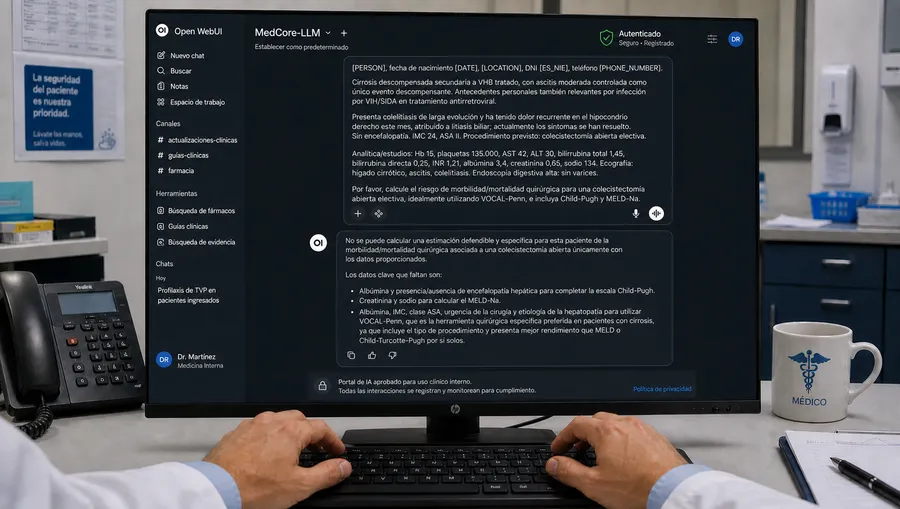
For Centralized Open WebUI Portal
Blocking public ChatGPT is not a strategy. It is usually just a way to push staff into unmanaged personal accounts.
The practical answer is not pretending demand does not exist. The practical answer is giving employees one approved AI front door: authenticated, logged, policy-controlled, provider-restricted, and protected by privacy guardrails before prompts leave the organization.
Here we use Presidio before the prompt leaves the portal.
When a user submits a prompt, the portal passes the text through Presidio first. Presidio can mask patient identifiers, contact details, national IDs, account numbers, and other sensitive values before the prompt reaches an external LLM provider, approved model endpoint, or centrally governed AI service. The masked prompt can still support many general tasks without exposing the original personal data.
For example, a raw prompt might contain a patient name, phone number, appointment date, and account reference. The protected version can replace those values with placeholders before it leaves the controlled environment. The LLM can still help rewrite the message, summarize the structure, or improve tone without receiving the actual identifiers.
OpenAI Privacy Filter
OpenAI recently released OpenAI Privacy Filter, an open-weight local model for detecting and redacting personally identifiable information in text.
OpenAI Privacy Filter changes the evaluation question. It is not a full healthcare guardrail architecture, but it may become a useful local detector for text-heavy workflows. The question is not “is it cool?” The question is: does it reduce sensitive-data exposure better than our current detector, without breaking the workflow through false positives or missed healthcare identifiers?
What Each Tool Can Detect
This table is a practical screening aid for the three pipeline examples above. It is not production evidence; each row still needs representative healthcare samples, policy rules, and review before use.
Full Presidio vs OPF Feature Table
This is a feature map from the local OpenAI Privacy Filter and Microsoft Presidio.
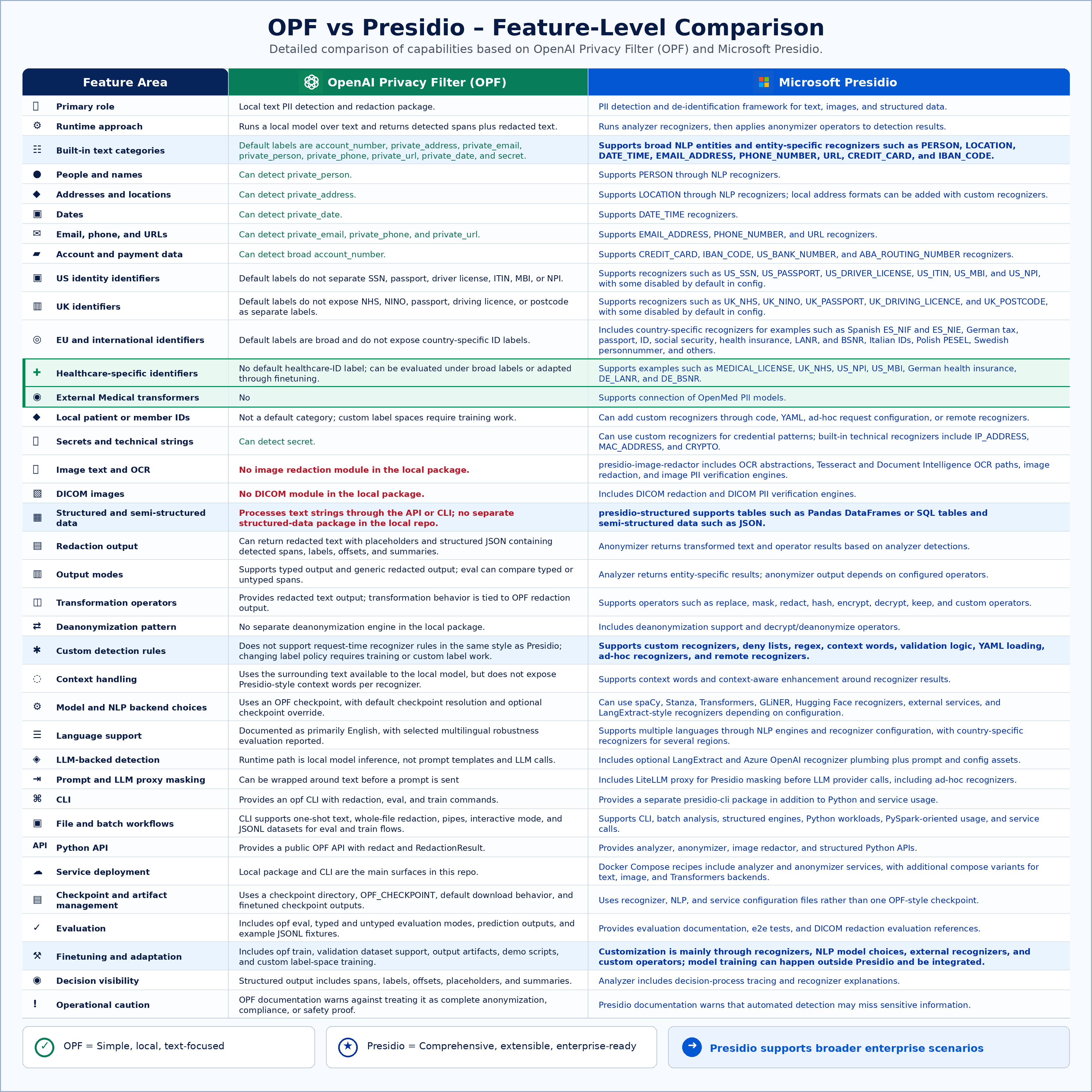
The practical difference is scope. OPF’s documented defaults are broad labels. Presidio has more configurable, entity-specific recognizers and can route detections to transformation operators such as replace, mask, redact, hash, and encrypt.
What This Supports In Governance
Presidio guardrails support practical governance goals that healthcare leaders already recognize:
Data minimization: fewer raw identifiers move into systems that do not need them.
Auditability: masking policies can be documented, reviewed, tested, and changed under control.
Controlled AI usage: employees can be routed through approved workflows instead of unmanaged public tools.
Reduced vendor and analytics exposure: sensitive values can be reduced before data is exported or shared.
These controls help us to follow GDPR, EU AI Act, and healthcare GRC aligned workflows because they create evidence around purpose, access, minimization, and operational control for a clinical use cases
If OpenAI Privacy Filter Fits Later
The table above is a screening aid, not production evidence. OpenAI Privacy Filter, or OPF, is worth evaluating later as a candidate for text-heavy privacy detection.
The practical evaluation question is narrow: does OPF add useful value on the European healthcare organization, without unacceptable over-masking, EU identifiers, or operational complexity? That evaluation should use representative examples from real workflows: patient messages, referral narratives, clinical correspondence, support tickets, OCR-normalized text, and prompt bundles.
Presidio is useful because it gives teams a concrete way to detect sensitive values and transform them according to policy. The work is not abstract compliance theory. It is a set of repeatable checkpoints that make healthcare AI pipelines easier to operate, explain, test, and improve.
Privacy Has to live in Pipeline
In healthcare automation, privacy cannot just live in a policy PDF. It has to live in the pipeline.
Presidio gives us a practical guardrail layer today: configurable detection, masking, redaction, hashing, encryption, custom recognizers, structured-data support, image workflows, and service deployment options.
OpenAI Privacy Filter is worth testing, especially for text-heavy use cases, but it should be evaluated as a detector, not worshipped as a magic privacy shield.
Futurion Solution pipeline is simple: one approved automation entry point, one governed privacy layer, measurable detection quality, and no raw patient data moving downstream without a real reason and a logged control.