Futurion Solutions
· Ivan Skachkov · Healthcare Workflow Automation · 6 min read
Healthcare Automation Must Be Built Differently
Healthcare automation must be architected around privacy, role-based access, auditability, interoperability, and human accountability from the start.
Everywhere on LinkedIn, I see posts about automating healthcare processes using large language models to access patient clinical data, make diagnostic decisions, assist with treatment workflows, and generate summaries.
Yes, AI can do all of that. And almost any automation agency can build a workflow that delivers one feature or another.
But the real question is not whether a workflow can be built. The real question is how the system is architected.
We are not talking about generating a kitten picture.
We are talking about people — our patients, their personal data, and, even more importantly, their privacy.
Privacy Cannot Be an Afterthought
This information is highly confidential. It cannot be shared with third parties without patient consent. It must remain within the EU, or at the very least with providers covered by the European Commission’s adequacy decisions.
It should not be passed to unknown third parties.
Do you know which subprocessors your provider is using? Are you certain those providers are not training models on your data or exposing it through commercial arrangements you do not control?
Because if there is a data leak, the responsibility sits first with your organisation, the one your client entrusted with the data, not with your subcontractors or software providers.
And privacy is only one part of the problem.
The Risk Is Also Inside the System
The system must be protected not only from external intrusion, but also from internal overexposure.
A nurse, for example, should not have access to the clinical history of every patient, only to the patients currently assigned to her.
And an accountant sending a message to a chatbot should not receive a patient’s entire clinical history when only payment-relevant information is needed.
Every action, and especially every AI-supported decision, must be properly logged.
And this is only the tip of the iceberg.
The Problem Is Not Limited to Automation Agencies
So how many generic agencies are actually thinking about these issues?
And the problem is not limited to automation agencies. Many SaaS vendors selling clinic management platforms still provide limited evidence of mature security and governance practices, including whether they actually hold certifications or compliance controls such as ISO27001, SOC2, or HIPAA-aligned safeguards.
Some mention third-party data sharing only briefly in their privacy policies. Many provide little meaningful detail about how patient data is handled, where it is processed, or which subprocessors are involved.
In many cases, they want you to move your clinical processes onto their platform, or they ask for direct, broad access to your clinical database, including personal data.
From there, the data is often routed to OpenAI, Google Cloud, or other third-party platforms, because in reality very few providers operate private any infrastructure of their own.
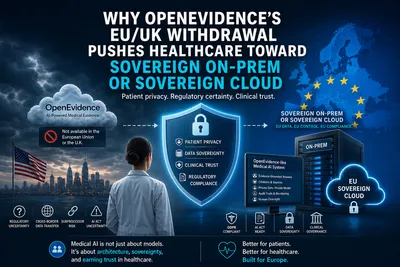
The OpenEvidence EU/UK withdrawal is a useful reminder that clinical AI risk often sits in the infrastructure and subprocessor chain, not only in the application UI.
And saying that a system runs on AWS or Google Cloud does not, by itself, guarantee effective security controls, a compliant architecture, or appropriate data residency.
In the worst-case scenario, patient data and documents are processed through tools like Google Docs, Supabase, or n8n, emails containing personal data are sent through public email services, or sensitive information is transmitted through apps like Telegram.
That is not innovation.
That is a disaster.
Healthcare Automation Must Start with Privacy
At Futurion Solutions, we believe healthcare automation must be built differently.
It must start with the client’s privacy, not with prompts.
In healthcare, AI should sit inside a controlled system with clear boundaries and guardrails.
Identity must be centralized. Permissions must be role-based and scoped. Healthcare data must be encrypted in transit and at rest. Workflow actions must be separated from the clinical record. Integrations must be explicit and bounded. And every relevant event must be auditable.
That means the workflow engine should orchestrate tasks, approvals, timers, escalations, and exception handling, but it should not become the place where clinical truth lives.
The source of truth must remain in the appropriate operational or clinical system.
It also means communication tools and automation adapters must be treated as adapters, not as owners of business logic and certainly not as owners of patient data.
Their role is to deliver, transform, and connect, not to quietly become the EHR or CRM.
AI Must Operate Inside a Governed Process
The same applies to AI.
An LLM can help draft a reminder, summarize a document, extract structured points from text, or support a human diagnostic workflow.
But it should do so inside a governed process, with clear access rules, clear logging, and clear human accountability.
No serious healthcare organization should accept a model making opaque decisions on top of unrestricted database access.
And no serious healthcare automation platform should require sending raw clinical data to unknown external providers just to make a workflow work.
Identity, Authorization, and Auditability Are Not Secondary Details
This is why identity and authorization are not secondary details. They are foundational.
A patient, a nurse, a doctor, an administrator, an auditor, and an integration service should never operate with the same level of access.
If your architecture does not enforce that separation, then your AI layer is already built on the wrong base.
The same is true for auditability.
If an AI-assisted recommendation changes a message, influences a workflow branch, or contributes to a staff decision, that action must be attributable.
Who triggered it? What data was used? Which system executed it? Who approved it? Where was the final outcome stored?
The human review is not a weakness in the process.
In healthcare, it is the point of the process.
Without those answers, you do not have trustworthy automation. You have ungoverned risk.
Interoperability Matters Too
Interoperability matters too.
Healthcare automation cannot depend on copying everything into black box. It must be able to work with existing clinical systems, scheduling systems, pharmacy systems, therapy workflows, and administrative tools.
That means using standards such as FHIR and openEHR where interoperability is required, while preserving durable clinical meaning instead of confusing workflow state with long-term health record semantics.
At Futurion Solutions, we are not interested in selling another replacement product your team should learn from scratch.
We provide an augmentation layer around the infrastructure you already have, so existing EHR, PMS, clinical, and administrative systems remain in place while workflows are strengthened rather than replaced.
That layer is designed to align with interoperability standards, privacy requirements, governance requirements, and operational best practices, and we make full infrastructure to run on client premises or in AWS European Sovereign Cloud.
From Demo to a Real Healthcare Platform
A good automation platform does not try to remove clinicians or staff from responsibility.
It removes repetitive friction, routes work correctly, prepares information safely, and ensures the right person can make the right decision at the right moment.
That is the difference between a demo and a real healthcare platform.
At Futurion Solutions, we are not interested in building fancy automations that sit on top of uncontrolled data access and hope for the best.
We are building architecture that healthcare organizations can actually govern, audit, localize, and trust in day-to-day operations, without forcing them to abandon the systems, controls, and responsibilities they already depend on.
Conclusion
The question is not whether AI can be added.
The question is whether it can be added responsibly.
Our free Automation Roadmap assesses your clinic’s data handling, compliance gaps, and automation opportunities, then gives you a clear implementation plan for responsible healthcare automation.