Futurion Solutions
· Ivan Skachkov · Healthcare Workflow Automation · 4 min read
Personalized Patient Treatment (PPT) Workflows in Healthcare: From Research to Real-World Automation
Healthcare personalization only works when workflow architecture is as adaptive, interoperable, and governed as the clinical decision itself.
Healthcare is moving beyond static protocols and generalized care pathways.
The future belongs to Personalized Patient Treatment (PPT) workflows — systems that adapt clinical and operational processes to the individual patient’s condition, history, risks, preferences, and real-time engagement.
Recent research such as A New Method to Create Personalized Treatment Guidance Using Patient Health Data demonstrates how modern healthcare systems can use patient-specific data, multisource evidence, and causal modeling to create generalizable personalized treatment rules that improve outcomes across populations.
But turning research-grade personalization into real healthcare operations requires something many organizations still underestimate:
the workflow architecture must be as personalized, interoperable, and governed as the clinical decision itself.
This is where Personalized Patient Treatment workflows become a strategic advantage.
What PPT Workflows Really Mean in Healthcare
Most organizations think of personalization only as AI prediction models or decision support rules.
That is only one layer.
True PPT workflows combine:
patient-specific clinical context
operational workflows
scheduling and appointment orchestration
reminder and rebooking logic
staff escalation pathways
communication preferences
care-team routing
human review checkpoints
compliance and auditability
long-term health record semantics
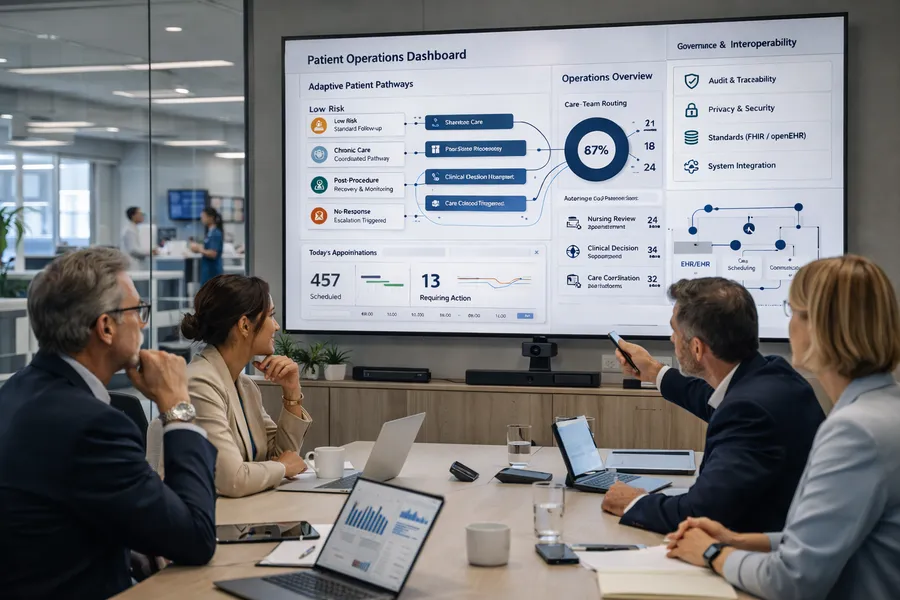
In practice, this means a patient with different risk factors, language preferences, engagement patterns, or follow-up needs should experience a different workflow pathway, not just a different recommendation.
For example:
A low-risk patient may receive:
automated reminder
self-confirmation
standard follow-up
A high-risk chronic-care patient may require:
reminder + no-response escalation
nurse review
follow-up care coordination
medication adherence workflow
clinical record persistence
additional decision support triggers
That is workflow-level personalization, and it is where real transformation happens.
Why Generic Automation Agency Approaches Do Not Fit Healthcare
Many agencies focus on quick wins:
faster reminders
SMS bots
basic scheduling flows
isolated CRM automations
disconnected chatbot experiences
no human-in-the-loop
weak PII and governance protection
These can improve short-term efficiency.
But they usually ignore the deeper healthcare requirements:
patient data governance
interoperability boundaries
source-of-truth ownership
clinical semantics
identity federation
privacy by design
durable audit trails
human override pathways
safe exception handling
long-term portability
This creates fragile automation that may “work” in a demo but becomes dangerous at scale.
The problem is not automation itself.
The problem is automation without healthcare-grade architecture.
The Futurion Solutions Difference: Governance + FHIR + openEHR
At Futurion Solutions, we deliberately take a different path.
We design Personalized Patient Treatment workflows using FHIR and openEHR methodologies from the start, not as an afterthought.
That changes everything.
1) FHIR for Workflow Interoperability
FHIR defines the operational interoperability layer.
In our appointment and patient workflow automation systems, resources such as:
Patient
Practitioner
Schedule
Slot
Appointment
Task
Communication
become the shared contract across systems.
This ensures that:
host EHRs remain authoritative
scheduling systems remain intact
automation layers remain portable
downstream systems can consume workflow outcomes safely
The result is automation that augments clinical systems instead of replacing them.
2) openEHR for Durable Clinical Meaning
Where most vendors stop at API integration, we extend into durable clinical semantics.
Using openEHR-aligned modeling principles ensures that:
workflow state remains operational
longitudinal clinical meaning remains protected
temporary automation shortcuts do not corrupt patient history
future portability across providers remains possible
patient pathways can evolve safely over years, not weeks
This is critical for:
chronic care
therapy coordination
oncology follow-up
medication adherence
post-discharge pathways
psychology and behavioral health programs
Real Example: Personalized Appointment Service Automation
A practical example is our appointment service automation workflow layer.
The workflow uses:
OAuth2/OIDC for secure patient and staff identity
FHIR for operational appointment resources
BPMN for reminder cadence and escalation
Workflow orchestration for communication delivery
OpenEHR methodology protecting clinical history
Human-in-the-loop Governance for AI-driven operational pathways
This means the system does more than send reminders.
It personalizes:
reminder cadence
no-response timeout rules
rebooking eligibility
escalation to nurses
tenant-specific routing
human-in-the-loop AI-driven checkpoints
specialty-specific dashboards
package release governance
The patient journey becomes responsive, safe, and clinically aligned.
That is the difference between workflow automation and PPT workflow engineering.
Privacy, Governance, and Security Are Not Optional Features
The biggest reason healthcare automation initiatives fail long term is simple:
They optimize for convenience before governance.
At Futurion Solutions, we reverse that.
Our design principles are:
privacy by design
data minimization
explicit source-of-truth boundaries
role-based access through the client identity manager
secure OAuth2/OIDC service accounts
patient/staff permission separation
audit-friendly workflow state
human review for clinical exceptions
standards-based interoperability
replaceable communication adapters
deployment portability across organizations
This makes our solutions suitable not only for clinics, but also for:
pharmacies
therapy providers
psychology consultancies
hospital outpatient services
chronic care coordination teams
population health programs
Why This Matters for the Future of Healthcare
The PCORI research proves that personalized treatment decisions must adapt across populations and care settings.
The same principle applies to workflow automation.
A reminder workflow, follow-up sequence, refill approval path, or post-discharge process cannot remain static when patient populations differ.
Healthcare organizations need:
personalized workflow logic
safe interoperability
durable semantics
governance-first automation
clinical adaptability
That is exactly the layer Futurion Solutions builds.
Build Healthcare Automation That Is Safe, Interoperable, and Future-Proof
If your organization is exploring:
appointment workflow automation
patient communication journeys
care coordination
therapy or psychology workflows
pharmacy automation
clinical admin orchestration
FHIR workflow integration
openEHR-aligned automation architecture
Futurion Solutions helps healthcare providers move beyond quick-win agency automation into secure, standards-based Personalized Patient Treatment workflows.
We combine:
FHIR interoperability
openEHR methodology
workflow orchestration
privacy-first governance
human-in-the-loop automation
AI-driven operational pathways
to help healthcare organizations automate safely without compromising patient data integrity.
If you want automation that improves outcomes and respects privacy, governance, and future interoperability, let’s talk.
Futurion Solutions builds the workflow layer that modern healthcare actually needs.
Research source: https://www.ncbi.nlm.nih.gov/books/NBK616692/